
Ever see those face tools on Instagram and wonder if they are legit? This guide explains how Face Cupping and Gua Sha actually help with TMJ pain, what makes them different, and how they can ease your jaw tension during a TMJ massage.
Intro
You know the feeling. You wake up in the morning, and the side of your face feels tight. Maybe your jaw clicks when you yawn, or you catch yourself clenching your teeth while staring at your laptop. You are probably dealing with TMJ issues. And honestly? It’s miserable.
TMJ – that is your temporomandibular joint. The hinge that connects your jaw to your skull. TMJ pain is very common, and many people are not sure how to deal with it. They may try painkillers or mouth guards, but they still feel stuck. But what if there was a softer, more natural way to get relief?
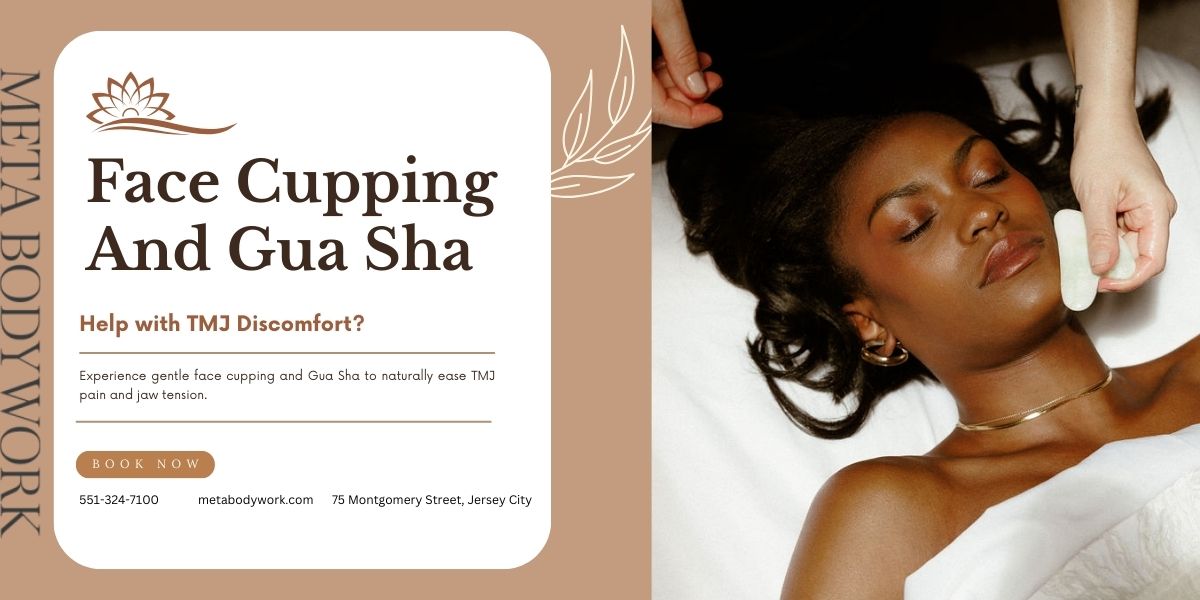
That is where face cupping and Gua Sha come in – two ancient techniques that work on jaw tightness and TMJ discomfort. At META Bodywork, our META Halo session combines these techniques to gently support TMJ relief in a calm, easy way.
If you are looking for a natural way to unclench and relax, let us dive into how these techniques actually work.
What Is TMJ Discomfort and Why Does It Cause Jaw Pain?
Before we get into the tools, let us look at what we are actually treating.
TMJ stands for temporomandibular joint – that is the joint right in front of your ears. This joint lets your jaw open, close, and move side to side. You have got one on each side of your face, and they are surprisingly complex joints that get used constantly throughout the day.
TMJ problems happen when something is off with your jaw joints or the muscles around them.
Here is what it feels like:
- Jaw pain, especially in the morning or after eating.
- Ear pain or ringing (even though your ears are fine).
- Pain near your temples, cheeks, or ears.
- Popping or clicking sounds when you open your mouth.
- Trouble opening your mouth all the way.
- Headaches.
- Jaw that feels stuck or locks up.
- Tight neck and shoulders.
Now, what causes TMJ issues? Usually, it is a mix of things:
- Clenching and grinding.
- Injury.
- Bad posture.
- Stress.
- Most TMJ pain comes from tight muscles around your jaw, face, and neck.
That is where face cupping, Gua Sha, and TMJ massage help. They relax tight muscles, increase blood flow, and reduce swelling, giving you real pain relief and making you feel better, even if the root problem is not fully fixed.
What Is Face Cupping and How Does It Work for Jaw Tension?
If you have seen photos of athletes with round purple circles on their backs and are scared. Well, let me tell you – face cupping is different!
It uses tiny suction cups on your face to ease tightness, boost blood flow, and help your skin recover. Do not stress. Facial cupping is much gentler. Gentle suction cups are placed on your face and moved around. This boosts blood flow, relaxes tight areas, and helps with lymphatic drainage.
So, how does it help with TMJ? Think of it as a reverse massage. Instead of pushing down into the muscle (compression), cupping uses gentle suction to pull the tissue up (decompression).
Face cupping helps in
- Relaxing muscles.
- Enhances blood flow.
- Reduces swelling.
- Releases tight tissues.
- Drains fluid.
- Relaxes your body and mind.
What Is Gua Sha and How Does It Work for the Face and Jaw?
Beauty influencers love Gua Sha for sculpting cheekbones; we love it for TMJ massage because it is excellent for breaking down tension.
Gua Sha is a traditional Chinese medicine technique that involves using a smooth tool (usually made of jade, rose quartz, or buffalo horn) to stroke the skin. Traditionally, it was used on the body for pain relief and healing. More recently, it has become popular for facial treatments – and for good reason.
The therapist gently glides it on your face, jaw, and neck. This is not harsh scraping. It is soft, steady strokes that move with the natural lines of your face.
For TMJ and jaw tension, here is what Gua Sha does:
- Relaxes tight jaw muscles.
- Breaks up stuck tissue.
- Drains fluid and reduces swelling.
- Boosts blood flow for healing.
- Calms your nervous system.
- Releases painful trigger points.
When done correctly by a trained therapist, it feels like a slow, soothing form of relaxing massage for your face.
Face Cupping vs. Gua Sha - Which One Helps TMJ More?
This is a question we hear a lot! Honestly, – they both help, just in slightly different ways.
The table will give you a better understanding of each feature.
Feature | Face Cupping | Gua Sha |
|---|---|---|
How It Works | Decompression. Uses gentle suction to lift skin and muscle up and away from the bone. | Compression. Uses firm strokes to press down and glide along the muscle fibers. |
Best For | Stiffness & Swelling. Perfect if your face feels “heavy,” puffy, or tight in the morning. | Knots & Tension. Perfect if your jaw feels “crunchy,” locked, or has specific painful trigger points. |
Key benefits for TMJ | Improves circulation, reduces puffiness, eases surface tension | Releases deep jaw muscles, reduces clenching, supports better jaw movement |
Primary Goal | Drainage & Circulation. Flushes out stagnant fluid and brings fresh blood to the area. | Release & Sculpting. Breaks up muscle adhesions and relaxes deep tension. |
Pressure level | Very gentle and soothing. | Medium pressure but still comfortable. |
The Sensation | A soothing, pulling sensation that creates space and blood flow. | A deep, “ironing out” sensation that releases stuck fascia. |
In our professional Meta Halo session – TMJ massage therapy, we often use both!
We might start with cupping to warm up the tissue and drain inflammation, then switch to Gua Sha to deeply work out the stubborn knots in your chewing muscle. Or we might alternate based on what your jaw needs that day.
Think of it like this: face cupping is like a deep massage for your jaw, while Gua Sha is like targeted pressure plus fluid drainage. They work great together.
What to Expect in a TMJ-Focused META Halo Session
If you are looking for a TMJ massage NJ residents trust, our signature Meta Halo service is where the magic happens. We do not just rely on one tool; we use a combination of techniques to get you the best results.
In a Meta Halo session, your therapist focuses entirely on the neck, shoulders, head, and face. Here is what you might experience:
- Manual Massage: We start with skilled hand techniques to warm up the muscles.
- Tools When Needed: We may use face cupping to reduce puffiness or Gua Sha to ease tight jaw muscles.
- Lymphatic Drainage: We help move out extra fluid so you feel less puffy and more relaxed.
- Neck and Shoulder Work: Since your jaw is connected to everything around it, we also work on your neck and shoulders. Releasing tension there helps your jaw relax too.
After your session, Most people feel better right away – their jaw feels looser, less painful, and more relaxed. You might be a bit sore the next day (like after any good massage), but that’s normal. The benefits usually get better with more sessions.
How often should you go? If your TMJ issues are ongoing, sessions every 2 to 4 weeks can help at first. Once things improve, you can switch to monthly maintenance. Your therapist will guide you on what works best for your needs.
It is a specialised form of massage therapy Jersey City locals love because it addresses the root of the pain rather than just skimming the surface.
Who Should Try TMJ Face Cupping or Gua Sha - and Who Should Avoid It?
While these tools are natural and generally safe, they are not right for everyone or every skin condition.
You Should Give It a Try If:
- You clench or grind your teeth.
- You wake up with headaches or a sore face.
- You want to improve facial circulation and reduce puffiness.
- You hold stress in your face and are looking for a TMJ massage.
- You sit long hours at a desk.
- You want natural TMJ relief without medication.
People who should avoid or ask first
- If you are pregnant.
- If you have broken, irritated skin or active acne.
- People with recent facial fillers or Botox.
- People with severe dental issues affecting jaw function.
- People who are on blood thinners.
- People with blood-clotting disorders.
Final Thoughts - A Gentle and Effective Way to Support Jaw Relaxation
Jaw pain affects how you eat, how you sleep, how you concentrate, and just how you feel in your own body. And when nothing has worked so far, it is annoying to still be dealing with it.
Living with jaw pain does not have to be your normal. While tools like face cupping and Gua Sha are not medical cures, they can be incredibly effective tools in your wellness toolkit.
They help improve blood flow, release stuck fascia, and remind your muscles what it feels like to actually relax. META Halo can help you feel what a truly relaxed jaw is like.
If you are ready to see how these techniques can help you, come visit us at META Bodywork. Whether you need a full body reset or a focused TMJ massage, we are here to help you feel your best.
Ready to unclench? Book your Meta Halo session today.
Top 5 FAQs about Face Cupping, Gua Sha, and TMJ Relief
Can face cupping really help with TMJ pain?
It may improve blood flow and loosen tight jaw muscles, helping reduce TMJ discomfort.
Does Gua Sha actually help with TMJ pain?
Yes. By gently scraping over the jaw muscles, it breaks up tight knots and fascia, helping your jaw relax and move more freely.
How long does TMJ relief from Gua Sha or cupping last?
Relief can last from a few days to a few weeks, depending on stress levels and habits like clenching. Regular sessions help maintain results.
Can face cupping and Gua Sha replace dental or medical TMJ treatment?
No, they can help, but they are not a replacement for proper dental or medical care.
How often should I do this for jaw pain?
For nagging pain, a professional session once a week is great to reset the muscles. Once you feel better, coming in once a month helps keep the tension away.
Can I get this massage if I have Botox or fillers?
You usually need to wait 3 to 4 weeks after injections to avoid moving the product. Always ask your doctor and tell your therapist before your session.
Disclaimer : This blog is for general wellness guidance and is not medical advice. Always check with a doctor or dentist if you have severe or ongoing TMJ issues.